
How a Seed-Stage Startup Landed Their Exact-Match .com Domain

What the deal actually cost, how it was paid for, and where founders lose money doing this alone
In 2014 a small hardware company called Doorbot had $187,000 left in the bank. Its founder spent all of it, and promised another $825,000 on top, to buy a single word.
Ring.com.
People around him thought he'd just killed the company. He hadn't. Four years later Amazon paid over a billion dollars for Ring, and the founder said that one domain had been worth somewhere between $30 million and $50 million to the business.
It's the best documented example we have of a seed-stage startup landing its exact match .com domain, and almost none of what he did shows up in the usual advice about buying a domain name. So let's go through it properly. What the deal looked like, what other startups have actually paid, how much you should be willing to spend at seed, and where founders lose money doing this themselves.
QUICK ANSWER
An exact-match .com is the .com that matches your brand name exactly, like Ring.com for a company called Ring. Nearly all of them are already registered, so getting one means buying it off the current owner rather than registering it. Reported startup purchases run from about $20,000 to several million. Two things save the most money: keeping your company's name out of the first approach, and paying over time instead of all at once.
KEY TAKEAWAYS
• Exact-match .com means the .com that matches your brand. It's not the SEO term exact match domain, which means a keyword address like buycheapsofas.com
• Ring paid $1 million for Ring.com in 2014, split as $187,000 on the day and $825,000 two years later
• There's no market price for a specific name. One seller, one buyer, and the number tracks how badly they want to sell
• The moment a seller works out that a funded startup is on the other end, the price moves. Reliably, and upward
• Instalment deals are a documented, standard product, so a thin bank balance doesn't rule out a six-figure name
• Budget the whole thing: price, representation fee, escrow at the right tier, transfer, and the rebrand afterwards
• After the registrant changes, ICANN rules lock the domain against registrar transfer for 60 days unless the old owner opts out first
What an Exact-Match .com Actually Means
It's the .com that's identical to your company name. Nothing added, nothing dropped. If you're called Leaf, that's Leaf.com. Not getleaf.com, not leafhq.com, not tryleaf.io.
This causes real confusion, because the phrase sounds like something out of an SEO blog. And there is an SEO term that looks almost the same. An exact match domain in that world means an address built out of a search phrase, like buyusedcars.com or plumberdallas.com. Completely different idea. Same two words.
Founders who mix them up end up reading five articles about whether keyword domains still help rankings, conclude that domains don't matter much anymore, and launch on a name they'll pay to replace in three years.
Two different things called exact match
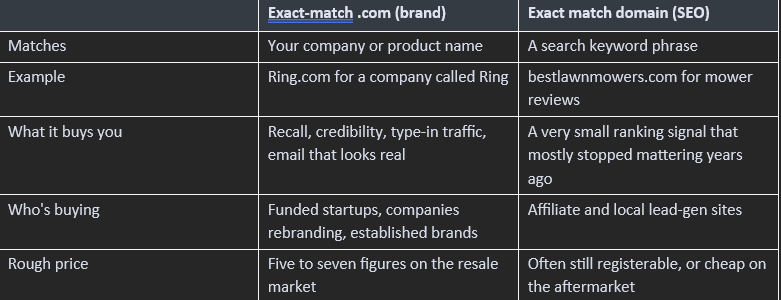
On the SEO side, Search Engine Land's look at the question landed roughly where practitioners already were: a keyword domain only does anything as part of a wider brand-led strategy, and it won't carry the site on its own. The brand-matching argument is a separate one, and it's aged much better.
EXAMPLE: DAILY-LIFE EXAMPLE
Try telling a friend where to buy something. "It's ring dot com" takes one breath. "It's get-ring-app dot i-o, that's i for india, o for orange" is a small negotiation. Every extra syllable is somewhere the referral can leak.
The marketing people TechCrunch spoke to made the same point in business language. A professional-sounding domain buys credibility with customers, candidates and investors before anyone reads a word, and a long or odd one quietly spends that credibility instead.
PRO TIP
Say your domain out loud to someone who's never heard of you, then ask them to type it. If they pause, or ask you to repeat it, that pause is happening every single time someone recommends you.
The Ring Story: $187,000 in the Bank, a $1 Million Domain
Most domain acquisition stories are rumours. This one isn't, because Siminoff eventually sat down and described the whole thing on a podcast.
CASE STUDY: DOORBOT BUYS RING.COM, 2014
Jamie Siminoff's video doorbell company was called Doorbot. It had been turned down on Shark Tank the year before, when he asked for $700,000 and got nothing. In 2014 he went after Ring.com, which was sitting with a doctor in Minnesota who'd registered it privately years earlier. The doctor wanted $1 million. Siminoff had $187,000. Rather than counter low, he offered the whole $187,000 immediately and committed to $825,000 in two years, covering the $813,000 balance plus $12,000 of interest for the wait. The doctor took it. Siminoff paid it. Amazon bought Ring in 2018 for more than $1 billion, and Siminoff later put the value of the domain itself at $30 million to $50 million, because it turned a product nobody could name into one people remembered. Source
The Ring.com deal, broken down
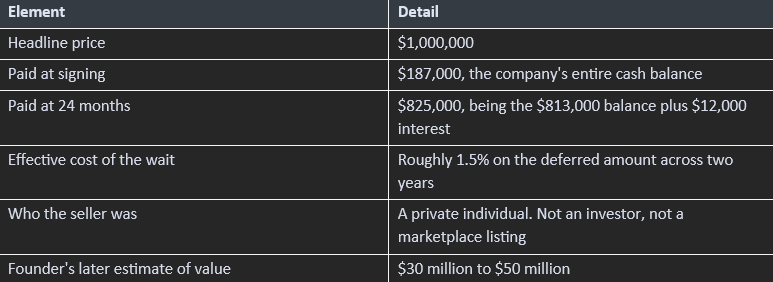
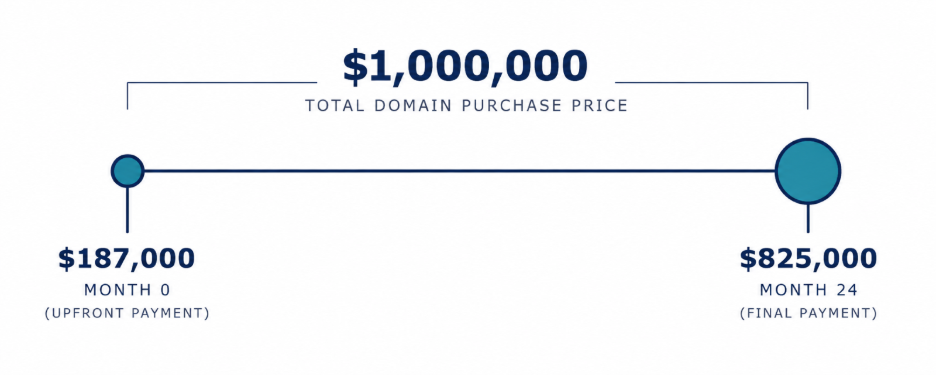
Now, the part worth copying has nothing to do with how much money Ring had.
He treated the price as a structure problem instead of a budget problem. The seller wanted a million. Siminoff couldn't produce a million. So he changed the shape of the payment rather than arguing about the number, which is a completely different conversation to have with someone.
He also made a real commitment instead of a smaller offer. Emptying the account said something that a $200,000 counter never would have. And he valued the name against the company it would build, not against a chart of comparable sales. A doorbell company called Doorbot and a doorbell company called Ring aren't the same business, and he knew it.
COMMON MISTAKE
Assuming a seller who names a big number has closed the door. Often they care about the total and the certainty far more than the timing. A properly documented instalment plan can be worth more to them than a lower pile of cash today.
Why Your .com Is Almost Certainly Taken
Because the good names went a long time ago. Verisign's Domain Name Industry Brief put the .com base at 163.6 million registrations at the end of Q1 2026, with 401.6 million across all extensions by the end of Q2. Every pronounceable single English word .com has been spoken for since roughly the Clinton administration.
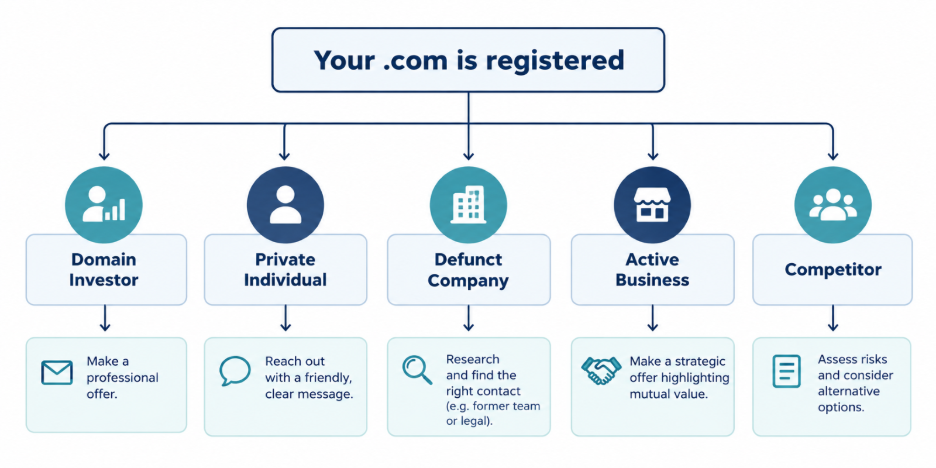
But taken isn't the same as unavailable, and this is where people give up too early. What matters far more than the name is who's holding it, because that changes everything about how you approach the situation.
Who's holding your .com, and what that means
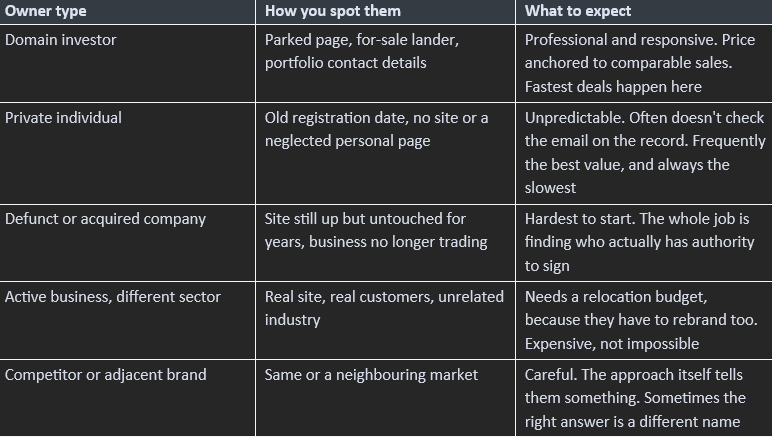
That bottom row is a big part of why so many well-funded companies end up launching on a name they don't love. We wrote about that pattern separately in why so many funded startups end up with awkward domains.
What Startups Have Actually Paid
There's no price list, because each name has exactly one seller. What there is instead is a public record of deals, and it's wide enough to be a useful reality check on whatever number is currently in your head.
Publicly reported startup .com acquisitions
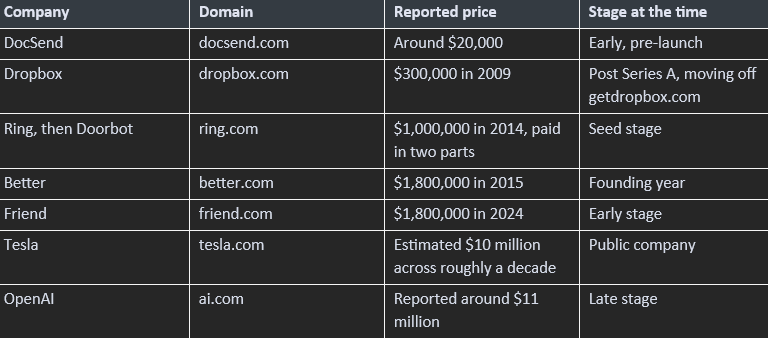
The DocSend number is the one seed-stage founders should sit with for a minute. Its founder has described finding an individual owner somewhere in Massachusetts and talking him into $20,000. Same type of asset, same type of company as Ring, roughly one fiftieth of the price.
That gap isn't about negotiating skill. It's about which human being happened to be holding the name that year.
Better's purchase is unusually well documented, incidentally, because the $1.8 million eventually turned up in a filing with the US Securities and Exchange Commission. Worth remembering that a domain purchase is a company asset and somebody will look at it during diligence.
NOTE
Use reported prices to calibrate your own expectations, not to argue about what your name is worth. A similar name going for $400,000 tells you what one buyer paid one seller on one particular day.
How Much Should a Seed-Stage Startup Spend?
There's no percentage rule, but there is a workable test. The purchase shouldn't change your runway math. If buying the name means you can't hit the milestone the round was raised for, it's the wrong call, however good the name is.
Olivier Toubia, who teaches marketing at Columbia Business School, put the risk bluntly when TechCrunch asked him about Friend's $1.8 million domain: a startup that's burned most of its cash without a product is going to struggle to raise again, no matter how sharp the branding looks. The name matters. It just isn't the thing investors are underwriting.
A sanity check by round size
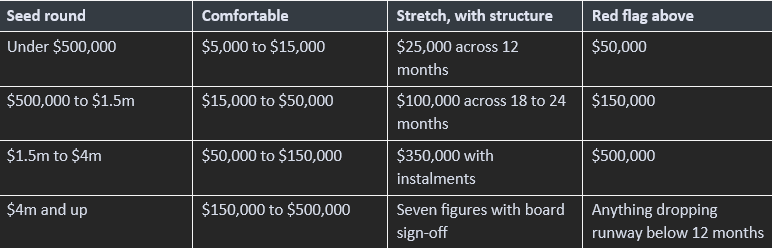
Treat those bands as a starting point for the conversation with your co-founders, not a rule handed down from anywhere. Two adjustments are worth making. Push the band up if word of mouth is your main growth channel, since the name is doing sales work every time somebody says it out loud. Pull it down if you're still finding out whether the product and the name survive the next two pivots.
EXAMPLE: BUSINESS EXAMPLE
Scenario: $1.2 million raised, 20 months of runway. A $60,000 name paid in three instalments of $20,000 costs about a month of runway spread across a year, and it happens before the brand has any equity to lose. Spend the same $60,000 after a Series A and you get the identical asset, plus redirects, email migration, app store updates and reissued contracts.
PRO TIP
The cheapest moment to buy your name is before anybody knows your name. Price pressure comes from the seller working out that you're committed, and launching is exactly what makes you look committed.
The Process, Step by Step
Five stages. Most attempts fall apart at the third one.
1. Work out who actually controls it
Start with a WHOIS lookup, which is the public registration record for a domain. Privacy services are standard now, so you'll usually get a proxy email and nothing else, and that's where the real work starts. Archived versions of the site. The registrar and name servers in use. Hosting. Company registry filings if there's a business on the record. Historical WHOIS where you can get at it.
If the name belongs to a company that folded, the job is finding the person or the estate that can legally sign. That can take weeks, and it's the single most common point at which founders quietly give up.
2. Decide what it's worth to you, before any contact
Write the number down first. You want three figures: a valuation from comparable sales, a target, and a walk-away ceiling. The ceiling is the one that matters, because it's your only defence against the seller's opening number becoming your reference point.
3. Approach without saying who you are
This is where deals are won and lost, so it gets its own section below.
4. Negotiate the whole deal, not just the price
Sellers respond to certainty and speed and a clean process, not only to the headline figure. Instalments, who covers the escrow fee, how fast funds clear, all of it is live. We've written about how these conversations actually go in the anatomy of a difficult domain negotiation.
5. Close through escrow
Never wire money straight to someone you've never met. There's also a transfer rule that catches nearly every first-time buyer, covered further down.
Before you make first contact
- Trademark search done in every market you operate in
- Archived site history checked for spam, adult content or penalties
- Comparable sales pulled, valuation range agreed internally
- Walk-away ceiling written down and signed off by your co-founders
- Second-choice name identified, so walking away is genuinely an option
- Decided who makes the approach, and under what identity
Why Founders Lose Money Approaching the Owner Themselves
The mechanism is embarrassingly simple. There's one seller, and they price the name against how badly they think you want it. Every signal that you want it badly pushes the number up.
So consider what a founder emailing from a company address is actually handing over. The domain in the signature gives away the current name, which gives away that you're operating on a compromise address. Thirty seconds of searching produces the funding round, the investors and the size of the raise. Now the seller knows you're committed, funded, and a bit embarrassed about your current name.
That's the strongest possible position to negotiate from. And you handed it over in the first message, before anyone mentioned a number.
COMMON MISTAKE
Sending the first approach from name@yourcompany.com. Sellers search the sender's domain before they reply. A funded startup in the signature is one of the most reliable ways there is to double an asking price.
Anonymity isn't a trick, and it isn't about being shifty. It keeps the conversation about the asset rather than about your balance sheet. Someone acting for you approaches as a principal, finds out whether the owner will sell at all, establishes a range, and only names the buyer once terms are agreed and escrow is opening.
EXAMPLE: INDUSTRY EXAMPLE
Scenario: two approaches on the same name in the same month. One comes from a founder's company address with a funded startup behind it and gets quoted $250,000. The other comes from a neutral representative with nothing identifying attached and gets quoted $60,000. Same asset, same week, one variable.
There's a quieter benefit too. If the owner won't sell, you've found that out without telling a stranger in your industry that you're unhappy with your name.
- Use a neutral email with no company domain in it
- Don't explain why you want it or what you're building
- Don't mention funding, a launch date, or a rebrand deadline
- Ask whether they'd consider selling before any number comes up
- Never open with a deadline. Urgency is a price signal
Valuing the Name Before You Make an Offer
Automated appraisal tools spit out a number in about four seconds. Treat it as a sanity check and nothing more, because the tool can't see the only thing that really sets the price, which is whether this particular person wants to sell this particular month.
A more useful valuation pulls three views together.
1. Comparable sales. What have similar names actually sold for recently, matched on length, dictionary status and category? That gives you a market band.
2. Replacement cost. What would it cost to build the same recall on a worse name? Count the extra paid search, the higher acquisition cost, the confusion tax on every referral.
3. Strategic value. What does the name unlock, or protect? Siminoff put Ring.com at $30 million to $50 million after the fact. You can't know that in advance. You can ask whether the name changes what kind of company you can credibly be.
Then set your ceiling from the lowest of the three you could defend to an investor. Not the highest one you can talk yourself into at midnight.
PRO TIP
Put the ceiling in a shared doc with your co-founders before the first reply lands. Ceilings set during a live negotiation move in one direction, every time.
Structuring the Payment When You Can't Pay Cash
A thin bank balance isn't automatically the end of it, and this is the part almost nobody writes about. Instalment purchases are a real, documented product. Not a handshake between two optimistic people.
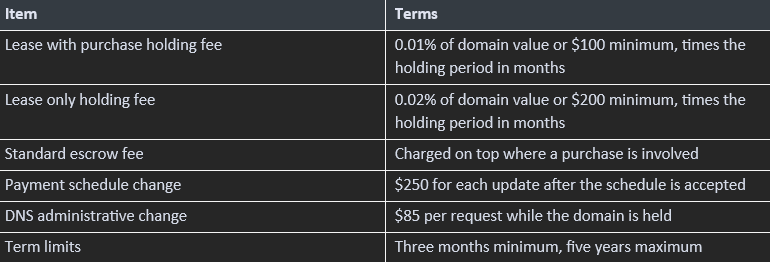
Escrow.com runs a Domain Name Holding service built for exactly this situation. The domain goes into the escrow provider's control while you make scheduled payments. The seller's protected because it can't be sold to anyone else in the meantime, and you're protected because the money is released against a signed agreement rather than a promise.
Escrow.com Domain Name Holding, as published by the provider
Ring's deal was a simpler version of the same idea, agreed privately between two people: big payment now, fixed balance in two years, small premium for the wait. The seller traded time for a higher total.
One trade-off to understand before you sign anything. In a formal holding arrangement you may not have full use of the domain while you're still paying for it, which means you could be funding a name you can't launch on yet. Check that against your timeline early, not after the agreement is drafted.
COMMON MISTAKE
Agreeing instalments without writing down what happens if you miss one. Decide up front whether a missed payment forfeits the earlier instalments, triggers a cure period, or unwinds the whole deal. Then put it in the agreement.
- Offer a higher total for a longer schedule, since time is the actual thing you're asking for
- Make the first payment big enough to prove you're serious
- Agree who holds the domain during the term, and whether you can use it
- Fix the interest or premium in writing instead of leaving it floating
- Check the registration has enough time left on it to cover the full term
What It Really Costs, All In
The purchase price is one line on a longer bill. Work out the whole thing before you agree a number, because a deal that stretches you at the headline figure will snap you at the total.
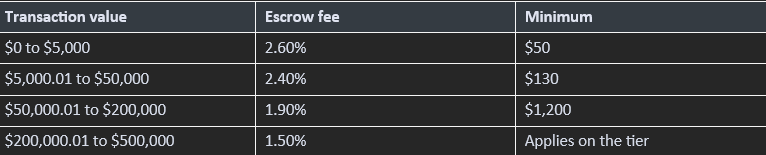
Escrow.com standard fee tiers after its 2024 pricing update
NOTE
Escrow pricing changes. Confirm the current schedule before you agree who pays, and treat the split as part of the negotiation rather than a fixed cost you absorb.
EXAMPLE: BUSINESS EXAMPLE
Scenario: a $50,000 purchase, closed through escrow, with a buy-side representative on a 15% success fee. Domain $50,000. Representation $7,500. Escrow at the 2.40% tier, $1,200. Registrar transfer and a year of registration, about $15. You're at roughly $58,715 before a single redirect gets written. Budget $50,000 for that deal and you're nearly $9,000 short.
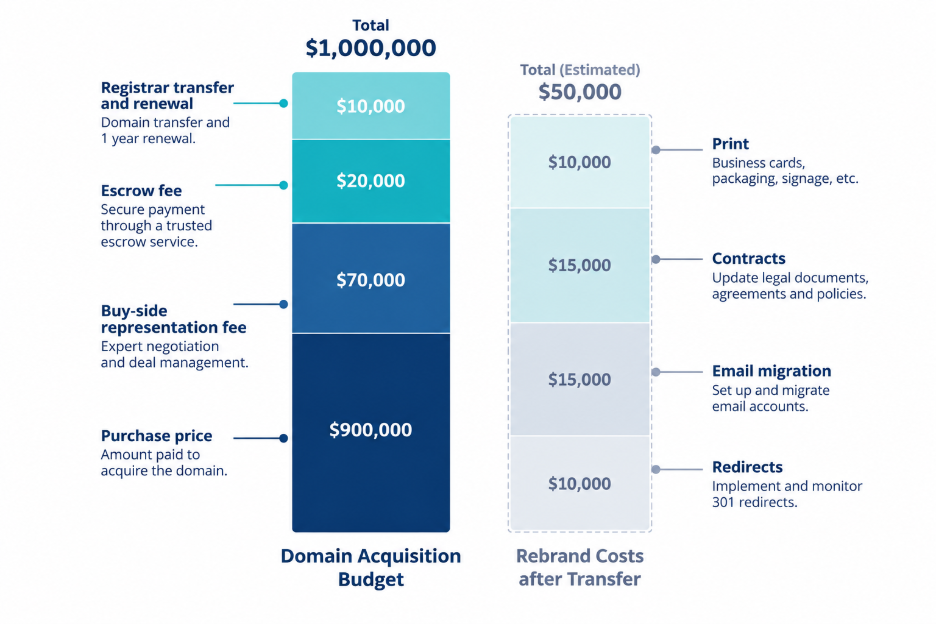
Then there's everything that lands after the transfer. Redirects, email migration, updated contracts and invoices, app store listings, social handles, anything you've had printed, and the search work needed when traffic moves from one address to another. If you've got any real footprint, that second bill can be as big as the first.
Moving an established site rather than launching fresh? Work through our domain checklist for companies rebranding or scaling before you close, not after.
Closing Safely, and the 60-Day Lock Nobody Warns You About
Domain sales attract fraud, because the asset is invisible and the payments are large. Escrow solves it: the provider holds your money until the domain is confirmed in your control, then pays the seller. No escrow, no deal, however trustworthy the other side seems and however much they'd rather not.
Now the detail that catches almost every first-time buyer.
Under ICANN's Transfer Policy, in force since 1 December 2016, registrars have to lock a domain against transfer to another registrar for 60 days after the registrant's information changes. Registrars can let the previous registrant opt out of that lock, but only if the opt-out happens before the change of registrant goes through.
In practice you'll own the name and be able to use it right away, and be unable to move it to your preferred registrar for two months. If consolidating registrars matters to you, raise the opt-out during negotiation, while the seller still has a reason to be helpful.
Closing checklist
- Escrow opened by typing the provider's address into your own browser, never through a link the counterparty sent
- Purchase agreement naming the domain, the price, the schedule and who pays which fee
- Inspection period short enough that the seller isn't left waiting on their money
- The 60-day change of registrant lock opt-out raised before the transfer
- Your registrar account secured with two-factor authentication before the domain arrives
- Registrar lock and auto-renew switched on the day the transfer completes
- Registration extended by several years once it's yours
COMMON MISTAKE
Tidying up the registrant contact details right after you acquire the domain, then trying to transfer it. That update starts a fresh 60-day lock. Move it first, tidy up afterwards.
When You Shouldn't Buy It
Plenty of good companies should skip this, at least for now, and it's worth saying so plainly.
If the name is still provisional, you're locking in a decision you haven't actually made. Wait until it's survived contact with real customers.
If the purchase breaks your runway, the answer is no. It stays no even when the seller mentions that the offer expires Friday, which it usually doesn't.
If there's a trademark conflict, owning the domain won't protect you and may make things worse. Somebody holding a registered mark on the same word in your category is a legal problem, not a domain problem. Clear that first.
And if the current owner is a direct competitor, approaching them tells them something genuinely useful about your plans and probably won't produce a sale anyway. Sometimes the right answer is a different name.
Where waiting makes sense, a decent modifier holds the position fine. Get and try are common enough that nobody blinks, and a short clean .co or .ai will carry a brand for a few years. Just treat it as temporary and keep the acquisition on the roadmap, because the cost of switching grows with every customer you add.
Frequently Asked Questions
What is an exact-match .com domain?
It's the .com that matches your business name exactly, with nothing added or removed. For a company called Ring, that's Ring.com. It's a branding term. Don't confuse it with the SEO term exact match domain, which means an address built out of a search keyword.
Can I buy a .com that's already registered?
Usually, yes. Almost any registered domain can be bought if the owner's willing and the price works. You're buying from the current owner rather than a registrar, either directly, through a marketplace if it's listed, or through someone who approaches the owner on your behalf.
How much does an exact-match .com usually cost?
There's no standard price, because each name has exactly one seller. Reported startup purchases run from about $20,000 for DocSend's domain up to $1.8 million for Friend.com. Most seed-stage deals on a brandable one-word .com land in the five to low six figures, but the spread is genuinely wide.
How did Ring buy Ring.com with almost no money?
Siminoff paid $187,000 upfront, which was every dollar the company had, and committed to $825,000 two years later. The seller accepted a delayed total instead of a smaller cheque today. The structure made the deal, not the budget.
Should a seed-stage startup spend money on a domain at all?
It depends whether the purchase changes your runway math. If the name is settled, word of mouth matters to your growth, and the cost doesn't stop you hitting the next milestone, buying early is much cheaper than buying later. If any of those three are shaky, wait.
Is it cheaper before or after raising funding?
Before, nearly always. The price tracks what the seller believes about your need and your resources. A funding announcement and a live company make you a visibly committed buyer, and committed buyers pay more.
Why stay anonymous when approaching the owner?
Because sellers price the name against the buyer, not against the market. An email from a funded startup's company address hands over your current name, your situation and your funding in one search. Buyers who stay neutral until terms are agreed consistently pay less.
How do I find out who owns a domain?
Start with a WHOIS lookup, the public registration record. Privacy services hide most of the useful detail now, so expect to keep going through archived versions of the site, the registrar and name servers, company registry records and historical WHOIS data. If a defunct company holds it, the job is finding who can legally sign.
What if the owner never replies?
Silence is normal and rarely means no. The email on the record is often years old and unread. Several contact routes, spaced across weeks rather than days, usually reach somebody eventually. This is a big part of why buyers use a representative, because persistence over months is a job in itself.
Broker or negotiate it myself?
Do it yourself when the name is listed at a fixed price you're happy to pay. Bring in a buy-side representative when the owner is unknown or unresponsive, when the name isn't listed anywhere, when anonymity matters, or when the value is high enough that a clumsy negotiation costs more than the fee.
What do domain brokers charge?
Commission generally falls between 10% and 20% of the final price, and some services add a non-refundable upfront fee on top. Success-only models mean nothing is owed if the acquisition fails. Check whether the quoted fee sits on top of the purchase price or inside it.
Do I really need escrow?
Yes. Escrow is a neutral third party holding your payment until the domain is confirmed in your control, then releasing the money. Domain fraud is common, the asset is intangible, and the fee is a small percentage of the transaction. There's no version of this where skipping it is smart.
What do escrow fees cost?
Escrow.com's published tiers after its 2024 update are 2.60% below $5,000 with a $50 minimum, 2.40% from $5,000 to $50,000, 1.90% from $50,000 to $200,000, and 1.50% above that. Who pays is negotiable, and it's often split.
Can I pay in instalments?
Yes. Escrow.com runs a Domain Name Holding service where the name sits with the escrow provider while you pay on a schedule, with terms from three months to five years. Private instalment agreements are common too. Check whether you can actually use the domain during the payment period before you commit.
Why can't I transfer my new domain to another registrar?
ICANN's Transfer Policy requires a 60-day lock against registrar transfer after the registrant's information changes. Registrars may allow the previous registrant to opt out, but only before the change is made, which is why it belongs in the negotiation rather than the handover.
Does an exact-match .com help SEO?
Not directly, in any way worth counting on. Keyword-matched domains lost most of their ranking value years ago. The brand-matching benefit is real but indirect: better recall, more direct type-in traffic, higher click-through rates, and a better chance of earning links. All of that helps search performance without being a ranking factor itself.
What should I check before buying a used domain?
Trademark conflicts in every market you operate in, the archived site history for spam or adult content, any existing backlink profile, whether it's been used in a penalised campaign, and how much registration time is left. You're buying the history along with the name.
Is a .co, .io or .ai good enough instead?
As a holding position, yes. As a permanent answer it costs you a little every time the name gets spoken rather than typed, because people default to .com. If you launch on an alternative extension, plan the .com acquisition rather than hoping the problem goes away on its own.
What happens to my rankings when I move to the new domain?
Done properly, with page-level 301 redirects, a change of address notification in Search Console and updated internal links, most ranking strength carries across, though a temporary dip is normal. Done badly, with everything redirected to the homepage, the losses can be heavy and slow to come back.
How long does an acquisition take?
A listed name can close in days. An unlisted name with an unresponsive private owner commonly runs one to six months, sometimes much longer. Tesla's acquisition of Tesla.com reportedly took about a decade. Build the timeline into your launch planning rather than the other way round.
What if I can't afford it right now?
Keep the relationship warm instead of closing the conversation. Owners' circumstances change, and the buyer who was polite two years ago is the one they call first. In the meantime, pick an interim name you can walk away from cleanly, and don't print it on anything expensive.
Summary
Getting the exact match .com domain for your brand is a negotiation problem dressed up as a budget problem. The seed-stage companies that pull it off usually aren't the ones with the most money. They're the ones who researched the owner properly, set their ceiling before the first message went out, kept their identity out of the approach, and stayed flexible about how the money moved rather than only how much of it there was.
Ring bought a million-dollar domain with $187,000. DocSend got theirs for $20,000 by finding the right person and asking nicely. Neither outcome came from a tool or an appraisal.
1. Write down your exact-match .com and check whether it's registered, listed for sale, or in active use
2. Run a trademark search on the name in every market you plan to operate in
3. Agree a valuation range and a written walk-away ceiling with your co-founders this week
4. Pick a second-choice name, so walking away is a real option rather than a bluff
5. Decide who makes the first approach, and strip every company identifier out of it
6. Ask whether the owner would consider selling before anyone mentions a number
7. Model the full cost: representation, escrow at the right tier, transfer, and the rebrand work
8. Raise the 60-day transfer lock opt-out during negotiation, not after closing
9. Close through escrow only, reached by typing the provider's address in yourself
If your .com is registered and you've no idea whether the owner would sell, that's worth finding out before you commit any further to a compromise name. Our frequently asked questions go into more detail on how the process runs, and you can book a consultation to talk through your specific name.