
Why So Many Funded Startups End Up With Awkward Domains
The naming pile-up happening across fast-growing categories right now, and what it means for the next wave of companies.
Why So Many Funded Startups End Up With Awkward Domains
Scroll through any list of recently funded companies and you'll notice a pattern. getsomething.com. trysomething.com. somethinghq.com. something.ai. Teams with millions in the bank and serious investors behind them, sitting on web addresses they'd never have chosen if they'd had a free pick.
This isn't bad luck. It's what happens when naming a startup collides with a domain market where the obvious names were registered decades ago, and where whole categories of companies chase the same handful of words at the same time. Right now that pile-up is worst in AI. It's quietly deciding how the next wave of companies gets remembered and recommended.
Here's why it happens, what the real trade-off between .io and .com looks like, where brandable domain names fit, and how to name a company so you don't end up paying to fix it later.
QUICK ANSWER
Funded startups end up with awkward domains because they usually name the company before they have money, assume the matching .com is out of reach without checking, and then try to buy it after a raise, when sellers can see they're able to pay. The fix is to check whether the .com is realistically attainable while you're still choosing the name. If it is, budget for it early. If the obvious words are gone, consider a brandable name instead.
KEY TAKEAWAYS
· There were 166.6 million .com domains registered at the end of Q2 2026, so most common words are gone
· .ai passed one million registrations in early 2026, a sign of how crowded the AI category has become
· The future of .io is still uncertain because of the planned handover of the Chagos Islands
· Modifiers like get or hq work as a stopgap but leak word-of-mouth traffic
· Brandable domain names are often easier to secure and to trademark than dictionary words
· The cheapest time to secure a name is before anyone knows your company exists
The Naming Pile-Up in Fast-Growing Categories
Start with the raw numbers. Verisign reported 166.6 million .com registrations at the end of Q2 2026, part of 401.6 million domain names worldwide. Nearly every short, pronounceable English word in .com has an owner.
Now add a hot category. When a wave of companies launches in the same space, they reach for the same vocabulary. In AI that means words like agent, pilot, mind, flow, labs and neural, combined in slightly different ways. The good versions of those names get bought first, then the second-tier versions, and the latecomers get what's left.
The AI boom shows up clearly in the data. The .ai extension, the country code for Anguilla, passed one million registered domains in early January 2026, according to figures reported by GIGAZINE. Every one of those is someone betting on the same two letters.
EXAMPLE: DAILY-LIFE EXAMPLE
It's like arriving late to a packed parking lot. The spaces near the door went hours ago. You can park at the far end (a modifier), park on the street (a different extension), or pay the person holding a spot near the door to leave. All three work. They just cost different amounts in different ways.
Five Reasons Funded Startups End Up With Awkward Domains
1. The name was chosen before there was any money
Most companies are named in a weekend by two or three founders with a credit card and a registrar search box. Whatever's available for $12 wins. By the time the company raises a round, the name is on the pitch deck and every investor update. Changing it feels impossible.
2. Founders assume the .com is out of reach without asking
A taken domain looks like a closed door. Many founders never find out whether the owner would sell, or for how much. Some of those names would have cost less than a month of a single engineer's salary.
3. They try to buy it after the raise
This is the most expensive pattern of all. A funding announcement is public. Anyone can find it in seconds. When a founder then emails the domain owner from a company address, the owner can look up the round and who invested in it within a minute. The price moves accordingly.
4. They follow the trend in extensions
In developer tools, .io became normal. In AI, .ai did. Both feel modern and clever at launch. Neither changes the fact that a large share of people type .com out of habit when they hear a company name.
5. They plan to fix it later
"We'll get the .com after the Series A" sounds sensible. In practice, every new customer, backlink, email address and printed asset makes the switch more expensive, and a bigger, better-known company is a richer target for the seller.
COMMON MISTAKE
Treating the domain as a branding detail instead of a financial decision. A name you'll replace in three years comes with two bills: the domain at a higher price, and the whole rebrand on top of it. Budget for it the way you'd budget for any other asset.
The Real Cost of .io vs .com
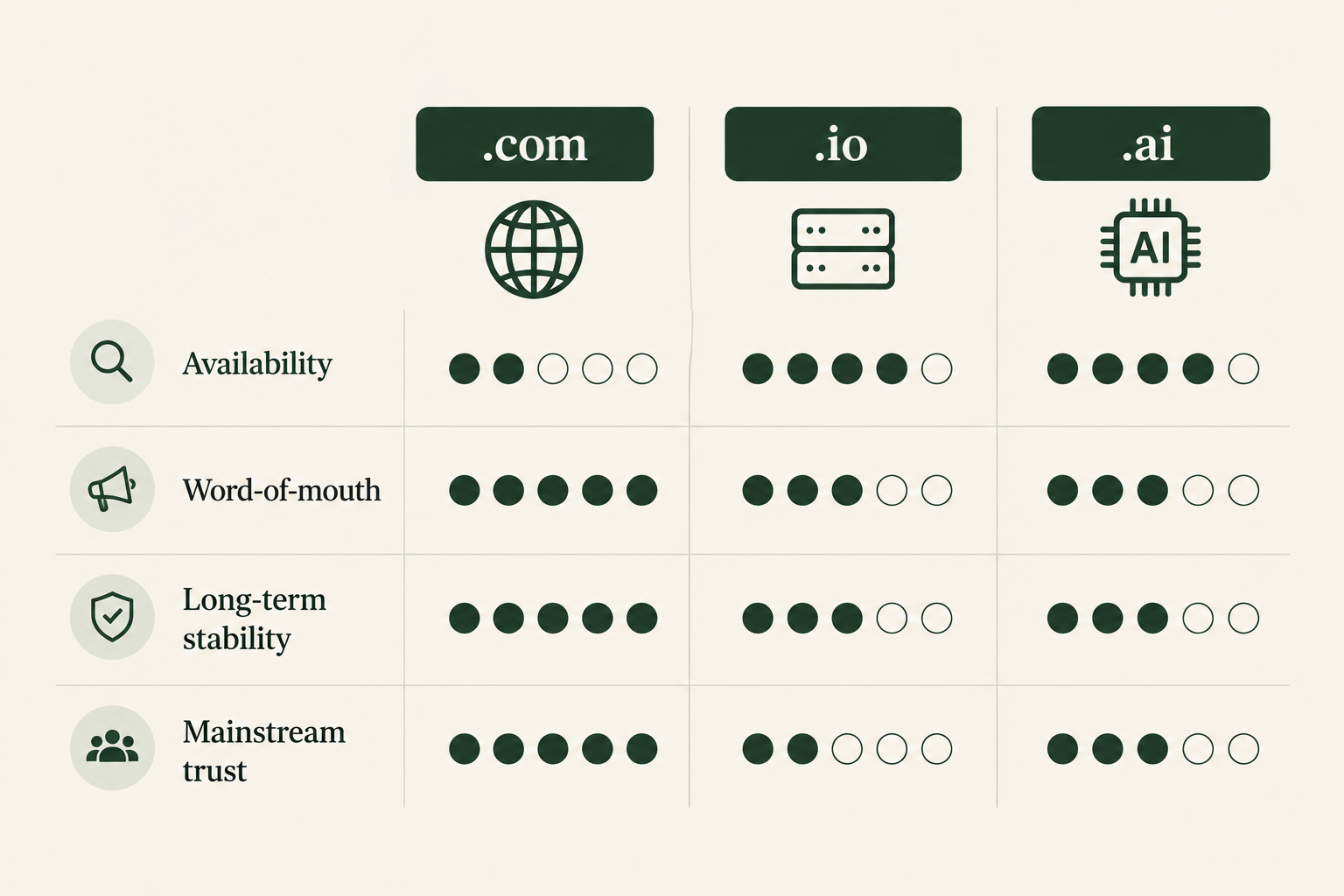
The .io vs .com question comes up in nearly every early naming conversation, so it's worth being specific about what each one gives you.
What .io gets you
· Availability. Short, clean names are far easier to find in .io than in .com
· Familiarity in tech. Developers and technical buyers are used to it
· A lower upfront cost, usually a registration fee instead of a negotiated purchase
What .io costs you
· Leakage. Some people who hear your name will type .com and land on someone else's site
· Email risk. Messages meant for you can go to the .com owner when people guess your address
· Political uncertainty. .io is the country code for the British Indian Ocean Territory. The UK agreed to hand sovereignty of the Chagos Islands to Mauritius, which raised questions about whether the code could eventually be retired under ICANN's country-code rules. As of April 2026 that deal was on hold, leaving the future of .io open
· Mainstream recognition. Outside tech, many customers don't trust or remember non-.com addresses as easily
What .com gets you
· The default people type when they don't know your address
· No dependence on a single country's politics or registry policy
· Easier word-of-mouth, since nobody has to explain the ending
· A stronger signal of permanence, to customers and future acquirers alike
The catch, of course, is price and availability. The good .com names usually have to be bought from someone, which is the whole reason this article exists.
NOTE
Popular extensions attract the same domain squatting problems as .com. In WIPO's 2025 domain dispute figures, both .AI and .IO were among the five country-code extensions with the most cases.
Where Brandable Domain Names Help
A brandable domain name is built around a word that's invented or repurposed, so it has no fixed meaning until your company gives it one. Google, Spotify and Zillow are all names like that. They don't describe anything on day one, which is exactly what makes them useful.
For a startup, brandable domain names have three real advantages:
· Availability. A coined word is far more likely to have an available or affordable .com than a common noun
· Trademark strength. Distinctive, invented names are generally easier to protect than descriptive ones
· Room to grow. A name that doesn't describe today's product won't box you in after a pivot
The trade-off is that a brandable name starts empty. You have to spend time and marketing teaching people what it means, where a dictionary word like Ring explains itself.
Three quick tests for a brandable name
1. The radio test. Say it once to someone. Can they type it correctly without asking how it's spelled?
2. The trademark test. Search it in every market you'll sell in. The USPTO trademark search covers the US.
3. The .com test. Is the matching .com available, for sale, or at least plausibly attainable?
EXAMPLE: BUSINESS EXAMPLE
Scenario: two AI scheduling startups launch in the same month. One calls itself AgentCalendar and lands on agentcalendar.ai because the .com is held by an investor. The other picks an invented name, Tavvo, and registers tavvo.com for the standard fee. A year later, the first company is negotiating for its .com from a much weaker position, while the second already owns its whole name.
A Better Way of Naming a Startup
You don't need a naming agency to avoid the awkward-domain trap. You need to do things in the right order.
1. Build a shortlist, not a favorite. Ten to twenty candidates, a mix of real words and invented ones.
2. Cut anything with a trademark conflict in your category before anyone gets attached to it.
3. Check the .com status of every survivor. Available, listed for sale, parked, or in active use by a real business.
4. Find out what the taken ones would really cost before you fall in love with any of them. This is where an anonymous inquiry pays off.
5. Pick the name with the best mix of fit, protection and attainable .com, not the one the founders liked first.
6. Budget for the domain in your raise if you need to buy it, the same way you'd budget for legal or hiring.
Step four is the one most founders skip, and it's the one that saves the most money. Our domain strategy consulting exists for exactly this moment: a plain-language read on whether a name is attainable and roughly what it would cost, before you commit to it.
PRO TIP
Check domain options before you file the company name with the state or announce anything publicly. Once a name is in a press release, sellers can find you as easily as investors can.
Already Stuck With an Awkward Domain?
Plenty of great companies started on a compromise address and upgraded later. If that's you, a few things make the upgrade cheaper and smoother:
· Do it sooner rather than later. Every quarter of growth adds to both the price and the migration work
· Keep the approach anonymous. Your funding and current domain should never appear in the first conversation
· Consider paying over time. Instalment deals are common for six-figure names
· Plan the migration before you close, so redirects, email and search settings are ready on day one
For a real example, see how Ring bought Ring.com with a fraction of the price in the bank in our seed-stage exact-match .com case study. If you're a fund or a portfolio company, our domain acquisition service for venture capital keeps the investor, the company and the round confidential throughout. For larger single purchases, see high-value domain acquisition.
Frequently Asked Questions
Why do so many startups use domains like getX.com or tryX.com?
Because the exact-match .com was already registered when they named the company, and adding a word was the quickest fix. It works as a stopgap, but some word-of-mouth traffic and email will go to whoever owns the plain .com.
Is .io or .com better for a startup?
.com is better long term because it's the default people type and it doesn't depend on any one country's politics. .io is easier to get and familiar in tech, so it's a reasonable starting point if you plan to secure the .com later.
Is the .io domain going away?
Nobody knows yet. .io belongs to the British Indian Ocean Territory, and the planned transfer of the Chagos Islands to Mauritius raised the possibility that the code could eventually be retired. As of April 2026 that deal was on hold, so .io continues to work, but the long-term question is open.
Is a .ai domain a good choice for an AI startup?
It's popular and signals your category instantly, which is why .ai passed one million registrations in early 2026. The downsides are the same as .io: people still default to .com, and it's a country code tied to Anguilla rather than a generic extension.
What are brandable domain names?
They're domains built around an invented or repurposed word that has no fixed meaning yet, like Spotify or Zillow. They're often easier to register or buy as a .com and easier to trademark than ordinary dictionary words.
How do I name a startup so the domain is not a problem?
Make a shortlist, cut names with trademark conflicts, check the .com status of each remaining name, and find out what the taken ones would actually cost before choosing. Pick the name with the best balance of fit, protection and an attainable .com.
When is the best time to buy the .com for my startup?
Before you raise and before you announce anything. Sellers price the buyer as well as the name, and a public funding round makes you look able and eager to pay more.
Does a .com domain help SEO?
Not directly. The extension isn't a ranking factor on its own. The benefits are indirect: more people type and remember your address correctly, more people click a familiar result, and more people link to you.
Can a funded startup buy its .com without the seller knowing?
Yes. A buy-side representative can approach the owner anonymously and keep the company, investors and round out of the conversation until terms are agreed and escrow opens.
Should I change my company name if the .com is too expensive?
Sometimes. If the name is still new and the .com would cost more than your runway can handle, picking a different name with an attainable .com is often cheaper than living with a compromise address for years.
What should I check before choosing a startup name?
Trademark conflicts in every market you'll sell in, whether the .com is available or attainable, whether people can spell it after hearing it once, and whether it still fits if your product changes.
How much does it cost to move from an awkward domain to a .com later?
Beyond the purchase price, you'll pay in redirects, email migration, updated materials and a temporary dip in search traffic. The bigger your company is when you switch, the higher both the domain price and the migration cost tend to be.
Awkward domains aren't a sign of a weak company. They're a sign of the order things happened in. Naming a startup well means checking the domain while the name is still a draft, weighing .io vs .com with clear eyes, and taking brandable domain names seriously when the obvious words are gone. Do that, and your company gets to skip a very expensive fix later.