
The Anatomy of a Difficult Domain Negotiation
What actually happens between the first outreach message and a signed purchase agreement.

The Anatomy of a Difficult Domain Negotiation
The reply comes in after nine days of silence. One line, no greeting: "$450,000. Not negotiable."
Most founders read that and reach the same conclusion within about ten seconds. This is domain squatting, the owner is holding the name hostage, and the fix is a lawyer and a domain name dispute. Sometimes that's right. Far more often it isn't, and acting on it turns a hard negotiation into a dead one.
Hard deals follow a pattern, and once you can see the pattern, the scary number stops running the show. Underneath almost every one of them sits a bigger question: is this person a squatter you can beat with a complaint, or a legitimate owner who simply wants a lot of money? The answer decides your whole strategy.
QUICK ANSWER
Domain squatting (also called cybersquatting) means registering a domain that matches someone else's trademark in bad faith, usually to sell it back to them or profit from their brand. Owning a generic word and asking a high price for it is not squatting. A domain name dispute under the UDRP only works when the name matches your trademark, the owner has no legitimate interest in it, and it was registered and used in bad faith. Miss any one of those and the complaint fails, so most hard deals are settled by negotiation, not by filing.
KEY TAKEAWAYS
· A big asking price is a negotiating position, not proof of bad faith
· The UDRP requires all three elements: confusingly similar to your mark, no legitimate interest, and bad faith registration and use
· A UDRP win only gets you the domain transferred or cancelled. No money changes hands
· WIPO filing fees start at $1,500 for one to five domain names with a single panelist
· If the domain was registered before your brand existed, a bad faith claim is very hard to prove
· Threatening a dispute you can't win usually ends the conversation and can backfire
· Most difficult deals get done by changing the terms (timing, structure, fees), not by arguing the number
What Makes a Domain Negotiation Difficult?
Buying a domain isn't like buying a car. There's no dealer down the road with the same model. There is one name and one owner. Then there's you, the buyer, who usually wants it more than the owner wants to sell. That imbalance is the root of nearly every hard negotiation.
In practice, deals turn difficult for a handful of reasons, and they often stack on top of each other:
· The owner has no need to sell. A name bought in 1999 for $35 costs a few dollars a year to keep. Saying no costs them nothing.
· The owner has done their homework on you. If they know a funded company is asking, the price reflects your bank balance rather than the name.
· The owner is emotionally attached. A former business, a family name, a project they never finished. Money alone rarely moves these people.
· The opening number is wildly high. Some owners anchor at ten times what they'd accept, just to see who flinches.
· Nobody replies. Silence is the most common difficulty of all, and it isn't the same as a no.
· There's more than one decision maker. Business partners, a spouse, an estate, a company board. Every extra person adds weeks.
None of these, on its own, means the owner is acting in bad faith. Hold on to that. It shapes everything that follows.
The Stages of a Hard Domain Negotiation
Every deal is different, but the difficult ones tend to move through the same five stages. Knowing where you are tells you what to do next, and more importantly, what not to do.
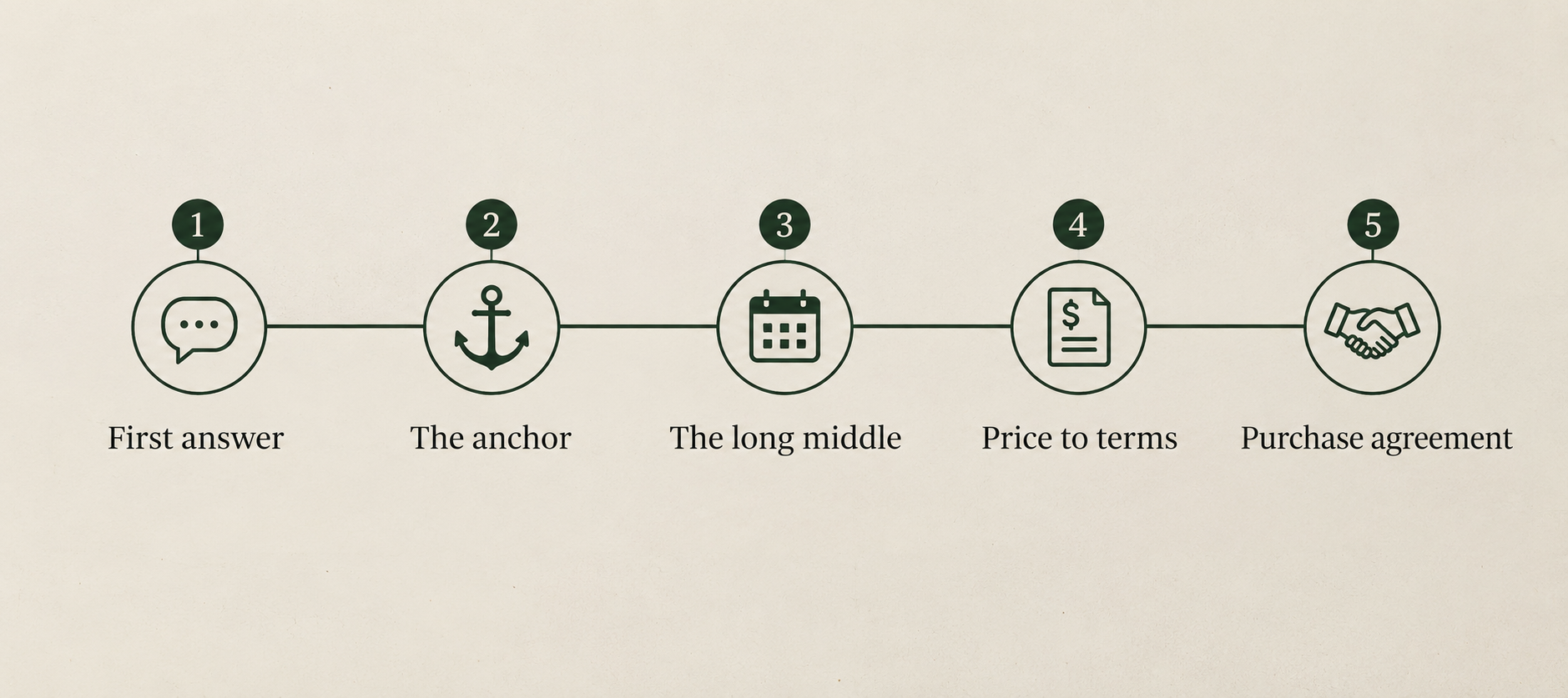
Stage 1: The first answer
The owner's first response usually lands in one of three buckets, and each means something different.
· Silence. Normal. Contact details go stale and people ignore unknown senders. It tells you almost nothing about willingness to sell.
· "It's not for sale." Often true today and false in six months. This is a door that's closed, not locked.
· A number. Good news, even when the number is absurd. Someone who names a price has admitted they'll sell.
Buyers tend to treat the third answer as the worst one. It's actually the best place to be.
Stage 2: The anchor
The first number either side names becomes the reference point for everything after it. Psychologists call this anchoring, and it works on experienced people too. If the owner opens at $450,000, every later figure gets judged against $450,000, even if the name trades in the $40,000 range.
The worst response is an immediate counter at $20,000. It tells the owner you'll negotiate inside their frame, and it often offends them enough to go quiet. A better move is to step outside the number entirely: acknowledge it, explain plainly that it's far beyond your budget, and ask whether they'd consider a different structure. You haven't bid against yourself, and you've kept the conversation open.
PRO TIP
Decide your walk-away price before the first reply arrives, and write it down. A ceiling set during a live negotiation only ever moves up.
Stage 3: The long middle
This is where most deals die, and they die quietly. Weeks between replies. Counteroffers that move $5,000 at a time. An owner who says they're "thinking about it" and then disappears over a holiday.
Patience is the main skill here. Every follow-up that sounds anxious signals urgency, and urgency is a price signal. The buyer who can wait three months without blinking usually pays less than the buyer who needs the name before a launch date. That's one reason a stated deadline is almost never a good idea.
EXAMPLE: DAILY-LIFE EXAMPLE
Think of a garage sale where you badly want one old chair. Hover around it for twenty minutes and ask the price twice, and the seller holds firm. Mention it once, walk away, and come back near closing time, and the price tends to drop. Domain owners read the same signals.
Stage 4: From price to terms
Hard negotiations rarely get unstuck by arguing about the headline number. They get unstuck when one side reframes the deal. The terms are where the room is:
· Payment timing. A higher total paid over 12 to 24 months can beat a lower lump sum for both sides
· Escrow fees. Who pays, or whether they're split, is real money on a six-figure deal
· Speed. Some owners value a fast, clean close more than the last $10,000
· Transfer details. Whether the seller will help with the registrar steps that follow a change of owner
The best known version of this is the Ring.com deal, where a doorbell startup with $187,000 in the bank bought a $1 million domain by paying part upfront and the rest two years later. We broke that deal down in our case study on how a seed-stage startup landed its exact-match .com.
Stage 5: The purchase agreement
Agreement in an email isn't a deal. The deal is the signed purchase agreement and the funds sitting in escrow. A solid agreement names the exact domain, the price, the payment schedule if there is one, who pays which fees, what happens if a payment is missed, and the timeline for the transfer. Escrow then holds your money until the domain is confirmed in your account, so neither side has to trust the other.
COMMON MISTAKE
Relaxing once the owner says yes. Deals still fall apart between verbal agreement and escrow, usually because the seller gets a second offer or second thoughts. Move to paperwork within days, not weeks.
Domain Squatting or Just an Expensive Domain?
Here's the question founders get wrong most often. Domain squatting, or cybersquatting, is registering a domain that matches someone else's trademark in bad faith, typically to sell it back to the brand owner or to cash in on the brand's traffic. It's a real problem and there are real remedies for it.
Domain investing is something else entirely, and it's legal. People buy generic words, short names and phrases because they're scarce and valuable, then sell them at a profit. A high price on a dictionary word isn't bad faith. It's a market.
So how do you tell which one you're dealing with? Look at the facts, not the price tag.
Signs it may be domain squatting
· The domain matches your distinctive, invented brand name (think a coined word, not an everyday one)
· It was registered after your brand was established or publicly announced
· It points to a page that trades on your brand, such as ads for your competitors
· The owner approached you, or your competitors, offering it for well above what they paid
· The owner has a pattern of registering other companies' brand names
Signs it is a legitimate owner with a high price
· The domain is a common word or phrase with many possible uses
· It was registered years before your company existed
· The owner uses it, or once used it, for a real business or project
· It's listed for sale publicly, open to any buyer, not aimed at you
EXAMPLE: BUSINESS EXAMPLE
Scenario: a startup called Quillary (an invented word) launches in 2024. In 2025 someone registers quillary.com, puts up ads for competing apps, and emails the founder offering it for $80,000. That has every hallmark of cybersquatting. Now compare a startup called Harbor asking about harbor.com, registered in 1996 by someone else. Harbor is an everyday word with thousands of possible users. The owner's high price is just a high price.
When a Domain Name Dispute Actually Helps
The main tool for fighting cybersquatting is the Uniform Domain Name Dispute Resolution Policy, known as the UDRP. It's an administrative process, not a lawsuit, and every registrar of .com and other generic domains is bound by it. Caseloads are climbing: WIPO, the largest provider, reported a record year in 2025 with more than 6,200 domain name cases.
The three things you must prove
Under paragraph 4(a) of the UDRP policy published by ICANN, a complainant has to prove all three of these:
1. The domain is identical or confusingly similar to a trademark or service mark in which you have rights
2. The current owner has no rights or legitimate interests in the domain
3. The domain was registered and is being used in bad faith
All three. Not two out of three. The third element is where most weak complaints collapse, because bad faith has to exist at the time of registration. If the owner registered the name before your company existed, they couldn't have been targeting you.
What a UDRP win gets you, and what it costs
The only remedies are transfer of the domain to you or cancellation of it. There are no damages and no legal fees paid back. On cost, WIPO's published fee schedule puts a complaint covering one to five domain names at $1,500 with a single panelist, or $4,000 with three panelists. Add your lawyer's time on top.
The court route
In the US, the Anticybersquatting Consumer Protection Act lets a trademark owner sue in federal court. The upside is money: 15 U.S.C. 1117(d) allows statutory damages of $1,000 to $100,000 per domain name, as the court considers just. The downside is everything that comes with federal litigation, including time and cost far above a UDRP filing.
When filing backfires
Filing a UDRP complaint against a legitimate owner can do real damage. Panels can make a finding of Reverse Domain Name Hijacking, which is a formal statement that the complainant tried to use the process in bad faith to take a domain it had no right to. That finding is published under your company's name, where it stays searchable for good. It also tends to end any chance of buying the name later.
COMMON MISTAKE
Opening a negotiation with a legal threat. If the claim is weak, the owner's lawyer knows it too, and you've just told the seller you're desperate and willing to be hostile. Keep the dispute option in your pocket and only raise it if the facts clearly support it.
Where Trademark Domain Name Rights Stop
Owning a trademark feels like owning the word. It isn't. A trademark protects your use of a name for certain goods or services in certain places. It doesn't give you the right to every domain that spells the same thing.
Delta is the classic example. Delta Air Lines and Delta Faucet both hold trademark rights in the same word, in completely different industries. Neither one could claim delta.com from the other just by pointing at a registration certificate.
A few practical limits are worth knowing before you lean on trademark domain name rights in a negotiation:
· Timing. If the domain was registered before your trademark rights existed, a bad faith claim is very hard to make
· Generic words. The more ordinary the word, the more legitimate uses exist, and the weaker your claim to it
· Different industries. A matching domain used for an unrelated business is usually fine
· Fair use. Criticism sites, fan pages and genuine noncommercial uses can count as legitimate interests under the UDRP
If your claim falls on the weak side of these lines, you're in a negotiation, not a dispute. Plan accordingly.
Mistakes That Make a Hard Deal Harder
Most difficult negotiations aren't lost to a stubborn owner. They're lost to small unforced errors on the buyer's side. These come up again and again:
· Revealing who you are too early. The moment the owner connects the request to a funded company, the price resets upward
· Bidding against yourself. Raising your offer twice before the owner has moved once
· Announcing a deadline. "We launch in six weeks" is the most expensive sentence in domain buying
· Getting emotional. Insulting the price, or the owner, ends conversations that might have closed
· Ignoring the terms. Fighting over $20,000 on price while giving away the escrow fees and the timeline
· No backup name. If you can't walk away, the owner will figure that out
Funded companies are especially exposed on the first point, which is why we built a dedicated process for anonymous domain acquisition for venture-backed companies that keeps the fund, the company and the round out of the conversation.
When to Walk Away, and How to Leave the Door Open
Some deals shouldn't close. If the price would damage your runway, if the owner is a direct competitor, or if your trademark position is weak and the owner knows it, walking away can be the smart call.
How you leave matters, though. Thank the owner, state your final number clearly, and say you'd be glad to hear from them if anything changes. People's circumstances change. Businesses close, estates settle, owners need cash. The polite buyer from two years ago is the one who gets the call.
PRO TIP
Keep a short record of every exchange: dates, numbers and anything the owner said about their reasons. When a stalled deal comes back to life a year later, that history tells you exactly where to restart.
How DomainConvo Handles Difficult Negotiations
Hard deals are most of what we do. Before anyone contacts an owner, we look at ownership history, comparable sales and whether the name is realistically attainable. Then a single senior negotiator handles the deal anonymously, from the first answer through the purchase agreement and escrow, so the owner is pricing the domain and not your company.
If you're stuck on a name right now, start with a domain strategy consultation to find out whether it's worth pursuing, or see how our high-value domain acquisition service runs a deal from first contact to close.
Frequently Asked Questions
What is domain squatting?
Domain squatting, also called cybersquatting, is registering a domain name that matches someone else's trademark in bad faith, usually to sell it to the brand owner at a profit or to make money from the brand's traffic. Buying generic words and reselling them is a different, legal activity called domain investing.
Is asking a high price for a domain illegal?
No. Owners can ask whatever they like for a domain they legitimately own. A high price only becomes evidence of bad faith when combined with other facts, such as the name matching your trademark and being registered after your brand was established.
What is a domain name dispute?
It's a formal process to get a domain transferred from someone who registered it in bad faith. Most disputes for .com and other generic domains run under the UDRP, an administrative procedure handled by approved providers like WIPO, rather than through a court.
What do I need to prove to win a UDRP case?
Three things, all of them: the domain is identical or confusingly similar to your trademark, the owner has no rights or legitimate interests in it, and it was registered and is being used in bad faith.
How much does a UDRP complaint cost?
WIPO's fee for one to five domain names is $1,500 with a single panelist and $4,000 with a three-member panel. Legal fees for preparing the complaint come on top of that.
Can I get money from a cybersquatter through the UDRP?
No. The UDRP only orders a domain transferred or cancelled. Money damages require a lawsuit, for example under the US Anticybersquatting Consumer Protection Act, which allows statutory damages of $1,000 to $100,000 per domain.
Does having a trademark mean I own the matching .com?
No. A trademark protects your use of a name for specific goods or services. Other businesses can hold rights in the same word in different industries, and a domain registered before your rights existed is very hard to claim.
What is Reverse Domain Name Hijacking?
It's a finding a UDRP panel can make when a complainant brings a case in bad faith, for example trying to take a generic domain it plainly had no right to. The finding is public and can hurt the complainant's reputation.
Should I threaten legal action to lower the price?
Only if you have a genuinely strong case and you're prepared to file. Empty threats usually end the conversation and tell the owner you're desperate. In most cases a calm negotiation gets further.
What does it mean when the owner says the domain is not for sale?
Usually that it isn't for sale right now, at the price they imagine you'll pay. Circumstances change, and many names marked not for sale have changed hands later. Leave the door open politely.
How long does a difficult domain negotiation take?
Anywhere from a couple of weeks to well over a year. Unresponsive owners, several decision makers and owners in other countries all stretch the timeline. Building in patience is part of the price.
Can I pay for a domain in instalments?
Often, yes. Instalment deals are common for six-figure names, and escrow providers offer services that hold the domain while you pay on a schedule. Put the terms, including what happens if a payment is missed, in the purchase agreement.
Why should a buyer stay anonymous during a negotiation?
Because sellers price the buyer as much as the name. If an owner learns a funded company is asking, the number usually goes up. Keeping the buyer's identity private keeps the conversation about the domain itself.
When should I walk away from a domain negotiation?
When the price would hurt your runway, when your legal position is weak and the owner won't move, or when the owner is a direct competitor. Set a written ceiling in advance so the decision is already made.
Difficult domain negotiations are rarely about villains. Most of the time you're dealing with an owner who has something you want and no pressing reason to sell it. Separate genuine domain squatting from a simple high price, use a domain name dispute only when the facts back it, and put your energy into terms, timing and patience. That's how hard deals actually close.