
What Does a Domain Broker Do? Buyer's Guide
What does a domain broker do? Learn what a buyer-side broker handles, how brokers charge, what they can't do, and when you actually need one.

What Does a Domain Broker Do? (And When Do You Actually Need One?)
What a buyer-side domain broker handles, how brokers charge, what they can't do, and how to tell whether your deal needs one. Last reviewed October 2026.
You've found the right name for your company, but someone else already owns the .com: no price on it, no listing and nothing on the page to tell you who's behind it. That's usually the moment people start searching for a domain broker.
So what does a domain broker do? Put simply, they negotiate a domain purchase or sale for one side of the deal, a bit like an agent in a property sale. Which side that is changes almost everything about the job, and so does the way the broker gets paid. This guide covers both. It also covers the limits of the job, and when buying without a broker is perfectly safe.
QUICK ANSWER
A domain broker is a specialist who negotiates a domain deal between the current owner and someone who wants the name. The buyer-side version works only for the buyer. They confirm who really controls the name and approach the owner without revealing who's asking. Then they negotiate the price and terms and close the deal through escrow. Most charge a commission or a retainer, sometimes both. A few charge nothing unless the deal closes.
KEY TAKEAWAYS
• A domain broker negotiates for a name someone already owns. A registrar only sells names nobody has registered yet.
• Before anything else, ask whose side the broker is on. A seller's broker is paid to get the highest price.
• Commission is the most common fee, and most published rates fall between 10% and 20% of the final price.
• No broker has the power to force a sale, fix a date or fight a legal dispute for you.
• You likely need one when the name isn't listed, the price could be high, or your company's name would push it higher.
What Does a Domain Broker Do?
Think of a domain broker as a go-between. One person owns a domain name and another wants it. The broker runs the conversation in between, aiming for a deal at a fair price. Most of that work happens in the aftermarket, the market for names that are already registered, which is where most short, memorable .com names now sit. Verisign counted 166.6 million .com registrations as of June 30, 2026.
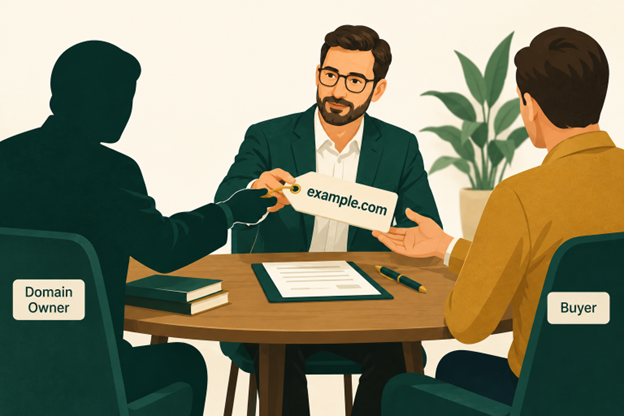
The day-to-day work looks similar on both sides. Most brokers handle the same core jobs:
· Putting a realistic value on the name, based on reported sales of similar names.
· Running the conversation between buyer and owner, so neither side has to.
· Negotiating the price along with the terms, including when the money gets paid.
· Moving the money and the domain safely, typically through an escrow service.
Beyond that core, the job splits in two. Working for a seller means pricing a domain, marketing it and fielding offers. Working for a buyer means going after one specific name for one client. We work on the buying side, so that's the side this guide spends most of its time on.
Buyer-Side vs. Seller-Side Domain Brokers
Before you share anything, ask: whose side are you on? The answer tells you who they're really working for.
· A seller-side broker represents the domain owner. They're normally paid a share of the sale price, so a higher price is a better result for them and for their client.
· A buyer-side broker represents the person or company trying to buy. Their job is to get the name at the lowest fair price, on terms that suit the buyer.
· Brokers who work both sides aren't automatically a problem, provided they tell you plainly which side they're on in your deal.
Trouble starts when a buyer assumes the broker in the conversation is working for them. If the broker who answers your inquiry was hired by the owner, everything you mention, from your budget to your launch date, may end up shaping the price you're quoted.
What a Buyer-Side Broker Handles for You
The right buyer-side broker takes the whole acquisition off your plate. Here's what that covers, from the first conversation to the day the name lands in your account:
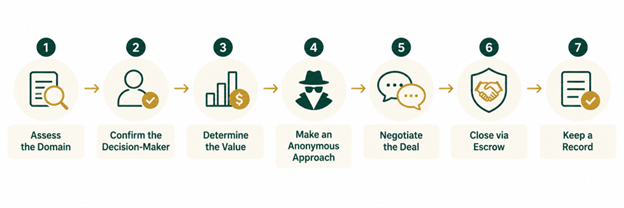
1. Assessment. Before any work starts, you should hear whether the name is realistically gettable and roughly what it might take. Sometimes the honest answer is no, and a strong alternative is the better use of your budget.
2. Confirming who controls the name. Public records often hide the owner, and the person on file isn't always the one who can agree to sell. A broker establishes who actually makes the decision before any offer goes out.
3. Valuation. Reported sales of similar names, the extension, the length and the current market all feed a realistic range, so you know what fair looks like before the owner names a number.
4. An anonymous approach. The owner hears from the broker, never from you. Your company name, your funding and your plans stay out of it.
5. Negotiation. Price is one lever. Payment timing, installments and the transfer steps are others, and they often matter just as much.
6. Closing. Money and domain change hands through escrow, so you're never wiring funds to a stranger and hoping the name turns up.
7. Notes for later. If the owner says no, a careful broker notes why, so any future approach starts from what's already known rather than from scratch.
Anonymity sounds like a nice extra until you see what happens without it. Here's a typical case.
EXAMPLE: SCENARIO (ILLUSTRATIVE NUMBERS)
Say a startup announces a $10 million round, then emails the owner of its exact-match .com from a company address. Within minutes the owner has looked the company up, found the funding news and asked for $250,000. Had the same first message come from a broker with no company attached, the talk would have been about what the domain is worth, not about what the buyer can afford.
Do You Need a Domain Broker?
Not always. Brokers earn their fee on hard deals and add little to easy ones, so it's worth working out which kind you're facing.
Signs you need one
· The name isn't listed for sale anywhere, and nobody has put a price on it.
· The price could run to five figures or more.
· Your company is funded, public or well known, so your name on an offer would push the price up.
· You've asked once already and heard nothing back, or a flat no.
· The owner is abroad, or the deal has several moving parts.
· You don't have weeks to spend chasing replies.
When you can skip one
· The name is listed at a fixed price you're happy to pay, on a marketplace that closes through escrow.
· It's a low-cost name, and a broker's fee would cancel out any saving.
· Nothing about you or your company would give the owner a reason to raise the price.
Even then, it's worth a quick word with a broker, since consultations are often free. Ten minutes will tell you whether a listed asking price sits far above what similar names actually sell for.
Is a Domain Broker Worth It?
For the right deal, yes. Whether it's worth it for yours comes down to two numbers: what the broker charges, and what the broker saves you.
How domain brokers charge
· Commission on the final price. The most common model. The rates brokers publish mostly sit between 10% and 20% of the purchase price, paid when the deal closes.
· Retainer plus a success fee. A smaller payment up front and the rest on success. If nothing closes, the retainer is gone.
· Flat or hourly fees. Some brokers charge a set fee for a defined piece of work, such as a valuation or a consultation.
· No fee unless the domain is acquired. You pay only if the name ends up yours. That's how we work.
The broker's fee is only one line on the bill. You'll also pay for the domain itself, the escrow fee and any registrar costs once the name moves to you. Ask for the fee in dollars at the price you expect to pay, not as a bare percentage, so you see the real number before you're attached to the name.
When a broker pays for itself
The obvious saving is on price. Keeping your identity out of the talks may stop an owner from pricing in your funding, and an experienced negotiator knows when to push and when to wait. The quieter savings are time and risk: a reluctant owner might mean months of on-and-off conversation that someone has to manage, and a closing done without escrow could go wrong in ways no discount would ever make up for.
Structure sometimes matters more than budget, too. When Doorbot, the company that became Ring, bought Ring.com, it paid $187,000 upfront and agreed to pay the balance two years later. We tell that story in how a seed-stage startup landed its exact-match .com.
What a Domain Broker Cannot Do
Knowing the limits protects you from a bad broker. Be wary of anyone who promises more than this list allows.
· Force a sale. The owner decides. Even with careful work, not every name is for sale at any price: across the domains clients ask us to acquire, roughly 70% end up acquired.
· Guarantee a price or a date. Some willing owners close within days, while our longest negotiation ran for about five years. A fixed timeline is a guess dressed up as a promise.
· Win a legal fight. If someone is using a domain that infringes your trademark, the normal route is a complaint under ICANN's Uniform Domain-Name Dispute-Resolution Policy or a court case, and that's work for a trademark lawyer. We focus on amicable negotiations and don't handle UDRP disputes.
· Fix a trademark problem. Any name that clashes with someone else's mark stays a liability however well it's bought. Check the USPTO trademark database before you commit.
· Make a weak name worth more. A broker's job is getting you a fair price. Turning the wrong name into the right one is beyond anyone.
COMMON MISTAKE
Paying a large fee upfront to a broker who guarantees success. No honest broker would promise the owner will sell, and a big payment in advance leaves you with nothing if they don't.
How We Work as Your Domain Broker
At DomainConvo, we're buyer-side domain brokers. That's all we do. We don't sell domains, lease them or represent owners. Our clients are mostly founders and established companies, along with venture capital firms buying for their portfolios, and most of them want an exact-match .com, though we'll take on other extensions when there's a clear strategic fit.
Every request starts with an honest assessment. If a name looks genuinely unavailable, or the deal isn't commercially realistic, we tell you instead of chasing it blindly, and we'll suggest comparable names where that makes sense. When a name is worth pursuing, we deal with whoever controls it, whether that's an individual owner, a company, a registrar or another broker, without ever revealing who you are.
Deals close through escrow, and there's no acquisition fee unless we acquire the domain. If you have a name in mind, book a free consultation and we'll give you a straight read on it.
Frequently Asked Questions
What does a domain broker do?
They handle the negotiation when a domain name changes hands, working for either the buyer or the seller. For a buyer, that means confirming who controls the name and approaching the owner without revealing the buyer, then negotiating and closing through escrow. For a seller, it means pricing and marketing the name.
What is the difference between a domain broker and a domain registrar?
Registrars sell names nobody has registered yet at a standard fee, then manage them once they're yours, while brokers work on names someone already owns, where the price has to be negotiated with that owner. Some companies offer both services.
Do I need a domain broker to buy a domain?
Not for every purchase. If the name is listed at a fixed price you're happy with, buying it yourself through a marketplace that uses escrow is fine. Brokers earn their fee on the harder deals, where a name is unlisted or the buyer's profile would push the price up.
Is a domain broker worth it?
For valuable or unlisted names, it generally is. Anonymity alone may keep an owner from pricing in your funding, and you get the negotiation and a safe closing handled for you. With a cheap name at a fixed price, a broker rarely adds enough to cover the fee.
How much does a domain broker charge?
Most take a commission, commonly 10% to 20% of the price. Some add a retainer at the start or charge flat fees instead. Others, ourselves included, charge nothing unless the deal closes. Ask for the fee in dollars, in writing, before any work begins.
Who pays the domain broker, the buyer or the seller?
Whoever hired the broker. A seller's broker is normally paid out of the sale, while a buyer's broker is paid by the buyer. If you're not sure which kind you're talking to, ask directly.
Will a domain broker keep my identity private?
Yes, and for most buyers that's the main reason to hire one. The broker handles every message, so the owner never learns your company name, your funding or your plans until the paperwork actually needs it.
Can a domain broker guarantee I'll get the domain?
No. The owner decides whether to sell, so treat any guarantee as a warning sign. What a good broker will promise is an honest assessment, careful negotiation and a safe closing.
How long does it take a domain broker to buy a domain?
Anywhere from a few days to many months. Willing sellers sometimes close within days or weeks, while a reluctant one might take months of on-and-off conversation. Our longest negotiation ran for about five years.
What happens if the owner refuses to sell?
Then there's no deal, and pushing rarely changes that. Owners' circumstances change, though. Some reconsider months later, which is why a careful broker records why a name was declined. Keep a backup name ready so one refusal doesn't hold up your plans.
Does a domain broker handle trademark disputes?
Not directly. Disputes over domains that infringe a trademark go through ICANN's UDRP process or the courts, and they need a trademark lawyer. A broker handles negotiated purchases, which is often faster when the owner is willing to sell.
Do domain brokers only work with .com names?
No, though .com is where most of the valuable names and most of the demand sit, which is why we focus on premium .com names and take on other extensions when there's a clear strategic fit. Most of our clients come to us for a .com.
What should I ask a domain broker before hiring one?
Ask whose side they represent, how they charge and what you owe if no deal closes. Then ask how they'll keep your identity private, which escrow service they use and who will actually handle your deal. Anyone worth hiring answers every one of those plainly.
Is it safe to buy a domain through a broker?
It is when the deal closes through escrow, which holds your payment until the domain is confirmed in your account. Walk away from anyone who asks you to wire money straight to a seller or wants a large fee before doing any work.
Will a domain broker handle more than one domain?
Yes. Companies often need several names over time, for new products, rebrands or other markets. We handle each acquisition as its own confidential deal, with terms agreed before any work starts.
The Short Version
In short, a domain broker negotiates a domain deal for one side. For buyers, that means assessing the name, confirming who controls it, approaching the owner without revealing who's asking, negotiating and closing through escrow. Hire one when the name is unlisted, valuable or likely to get pricier once the owner knows who wants it. Skip it when the price is fixed, fair and small.
What to Do Next
1. Write down the exact name you want, plus two backups you could live with.
2. Check the name against the USPTO trademark database.
3. Decide what the name is worth to your business before anyone mentions a price.
4. Ask any broker you're considering whose side they're on and what you owe if no deal closes.
5. Keep your company's name out of the first approach.