
How to Buy a Domain Name That Is Taken Lessons From a Seed-Stage Deal
A behind-the-scenes look at a negotiation that started as a firm "no," and where it actually ended up.

You've picked the name. The team likes it, the logo's half done, and then you type it into a registrar and get the message every founder dreads. Taken.
Most people stop right there and start adding words: get, try, app, hq. That's often a mistake. Knowing how to buy a domain name that is taken is one of the most useful skills a founder can have, because registered and unavailable are two different things. Plenty of taken names change hands every week, including one-word and short domains that seem completely out of reach.
Below is how the process actually works, what these names really sell for, and what one seed-stage startup did when the domain it needed cost far more than it had in the bank.
QUICK ANSWER
To buy a domain name that is taken, you buy it from its current owner rather than a registrar. If it's listed for sale, you can purchase it directly and close through escrow. If it isn't listed, someone has to identify the owner, approach them (ideally without revealing who the buyer is), negotiate price and terms, and close through escrow. Prices vary hugely: reported sales of one-word .com domains range from tens of thousands to well over a million dollars.
KEY TAKEAWAYS
· A taken domain is registered, not necessarily unavailable. Most owners will sell at some price
· There were 166.6 million .com registrations at the end of Q2 2026, so nearly every good word is spoken for
· Listed names are simple to buy. Unlisted names are where the real work, and the real savings, happen
· Reported one-word .com sales in early 2026 include Midnight.com at $1,150,000
· Short domain names are scarce and priced that way. C4.com reportedly sold for $265,000
· Ring bought Ring.com for $1 million with only $187,000 in the bank by paying over time
· Revealing a funded company as the buyer is the fastest way to raise the price
What "Taken" Actually Means
When a domain shows as taken, it simply means someone has registered it. It says nothing about whether they're using it or even care about it. And it certainly doesn't tell you if they'd sell.
The scale explains why your first choice is almost always gone. Verisign reported 166.6 million .com registrations at the end of the second quarter of 2026, out of 401.6 million domains across all extensions. Every common English word in .com was registered a long time ago.
In practice, a taken domain usually sits with one of these types of owner:
· A domain investor who holds names to sell. Usually willing to sell, often at a high price. Still the most predictable owner to deal with
· A business actively using it. The hardest case. They'd be selling part of their identity, so the price reflects that
· A business that closed or moved on. The name may be sitting with a former founder, an acquirer or an estate
· An individual who registered it years ago for a project that never happened. Often open to a fair offer, if anyone can reach them
· A parked page with ads. Someone is earning a little from the traffic and may be happy to cash out
Who the owner is changes everything about the approach and the likely price, which is why serious buyers figure that out before they make any move.
How to Buy a Domain Name That Is Taken, Step by Step
Here's the process from the buyer's side. Some steps take an afternoon. One of them can take months.
1. Make sure this is the name you will keep
Before spending anything, confirm the name has survived real conversations with customers and investors. Then run a trademark search in every market you plan to sell in. In the US, the USPTO trademark search is the starting point. Owning a domain doesn't protect you if another company already holds the trademark in your category.
2. Check whether it is openly for sale
Some taken domains show a for-sale page or appear on a major domain marketplace with a fixed price or a make-offer button. If the listed price works for you, this is the easy path: buy it, close through escrow, done. If the price doesn't work, a listed name is still a negotiation, just one with the door already open.
3. If it is not listed, this is the hard part
Most valuable names aren't listed anywhere. That means working out who can legally sell the domain and approaching them in a way that doesn't push the price up before talks even start. This step decides more of the final price than any other, and it's the part most founders get wrong when they try it themselves, usually by sending a hopeful email from their company address.
It's also the core of what a buy-side broker does. Our high-value domain acquisition service handles this stage anonymously, so the owner never learns which company is asking until terms are agreed.
4. Put a value on it before you talk numbers
Decide what the name is worth to you before the owner names a price. Look at comparable sales of similar names, think about what it would cost to build the same recognition on a weaker name, and agree a walk-away ceiling with your co-founders. Automated appraisal tools give a number in seconds, but they can't see the one thing that really sets the price: whether this owner wants to sell right now.
5. Negotiate the price and the terms
The headline number isn't the only thing on the table. Payment schedules, who pays escrow fees and how fast the deal closes all have value. Sellers who won't move on price will often move on structure.
6. Close through escrow and secure the transfer
Never send money straight to an owner you don't know. A licensed escrow service holds your payment until the domain is confirmed in your registrar account, then pays the seller. Plan for a registrar rule that catches many first-time buyers too: after a change of owner, the domain is normally locked against moving to another registrar for 60 days unless the seller opts out beforehand. We cover the closing details in our seed-stage exact-match .com case study.
COMMON MISTAKE
Telling the owner why you want it. "We just raised our seed round and launch next month" is the most expensive sentence a buyer can write. Keep the approach about the domain, not about you.
What One Word Domain Names Actually Sell For
One word domain names are the top of the market. They're short, easy to say, easy to remember and impossible to misspell, and there's a fixed supply of them. That's why the prices look the way they do.
Some recent reported sales give a sense of the range. DNJournal's sales chart for the turn of 2025 into 2026 listed Midnight.com at $1,150,000, Gamefi.com at $300,000 and HealthStrategy.com at $100,000. Ring.com, the name at the center of the seed-stage story below, went for $1 million back in 2014.
What pushes a one-word .com toward the top of the range:
· A common, positive word that many different businesses could build on
· Clear commercial meaning, where the word itself describes something people buy
· Easy spelling. If people can type it correctly after hearing it once, it's worth more
· The .com extension. The same word in another extension usually sells for a fraction of the price
· How badly the seller wants out, which no appraisal tool can measure
NOTE
Reported sales are a reality check, not a price list. Each name has exactly one owner, and the same word can sell for very different amounts depending on who's selling and when. Many large deals are private and never reported at all.
What Short Domain Names Sell For
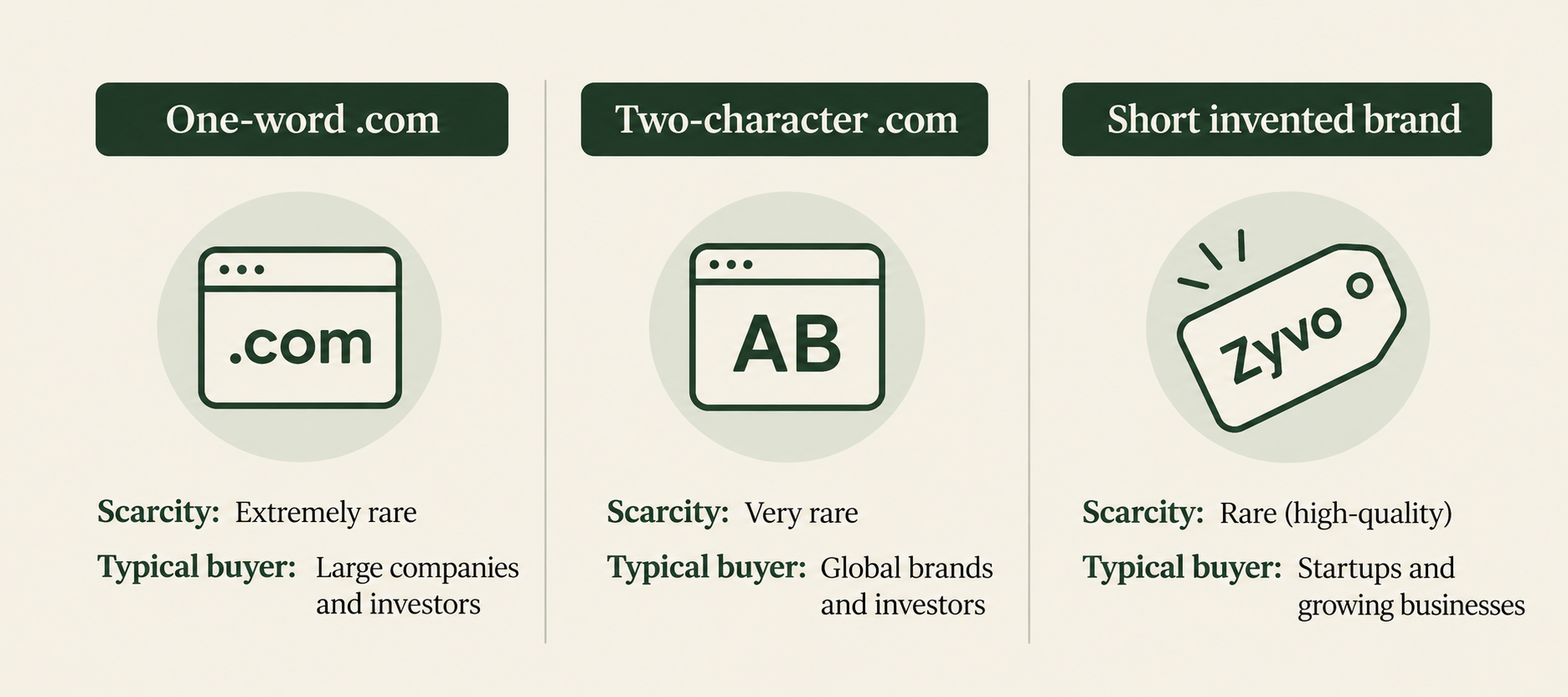
Short domain names usually means two, three or four characters, or a short made-up word that's easy to say. They're valuable for a different reason than one-word names. A three-letter .com can be the initials of hundreds of companies, so many buyers compete for the same few combinations.
Two-character names are the rarest of all. C4.com reportedly sold for $265,000 in early 2026, according to the same DNJournal chart. Three-letter names vary far more, depending on whether the letters form a known acronym or a pronounceable word.
For most seed-stage companies, a short invented brand name is a more realistic target than a two or three-letter acronym. Names like that tend to be cheaper to acquire, easier to trademark and still very easy to say out loud.
A Real Seed-Stage Deal: How Ring Paid for Ring.com
The best documented example of a young startup buying a taken domain is Ring. In 2014 the company was still called Doorbot, and the owner of Ring.com wanted $1 million. The company had about $187,000.
Instead of countering low, founder Jamie Siminoff offered all of it upfront and agreed to pay the rest two years later, with a small premium for the wait. The owner accepted. Four years later Amazon bought Ring, and Siminoff later valued the domain itself in the tens of millions, as reported by DNJournal.
Three lessons carry over to almost any seed-stage deal:
· Change the shape of the payment, not just the number. A seller who won't drop the price may accept time
· Show real commitment. A large first payment says more than a slightly higher counteroffer
· Value the name against the company it will build, not only against a list of comparable sales
We break the full deal down, including what startups typically budget and the closing steps, in How a Seed-Stage Startup Landed Their Exact-Match .com Domain.
Should You Buy the Taken Domain or Pick Another Name?
Buying isn't always the right answer. Ask yourself four questions:
1. Is the name final? If it might change after the next pivot, wait.
2. Does the price change your runway? If it stops you hitting the milestone you raised for, don't do it.
3. Is the trademark clear? If another company owns the mark in your space, the domain won't save you.
4. Does word of mouth drive your growth? If people mostly hear about you out loud, a clean .com pays for itself faster.
If the answer isn't a clear yes, a sensible interim name works fine for a while. Just treat it as temporary, because every customer you add makes switching later more expensive. A domain strategy consultation can help you decide whether to pursue the name now, wait, or switch.
Mistakes Founders Make When Buying a Taken Domain
· Giving up the moment a registrar says taken
· Contacting the owner from a company email that reveals the brand and its funding
· Naming a price first, before knowing what the owner expects
· Mentioning a launch date or deadline
· Paying outside escrow because the seller seemed trustworthy
· Forgetting the costs that come after the price, especially fees and the rebrand itself
· Having no backup name, so walking away isn't a real option
Funded companies feel the second mistake most. If you've recently raised, our domain acquisition service for venture-backed companies keeps the fund, the company and the round out of the conversation entirely.
Frequently Asked Questions
Can you buy a domain name that is already taken?
Yes, in most cases. A taken domain is registered to someone, and most owners will sell at the right price. You buy it from the owner, not from a registrar, and close the sale through escrow.
How much does it cost to buy a taken domain?
There's no fixed price because every name has one owner. Small or obscure names can sell for a few thousand dollars, while reported one-word .com sales run from tens of thousands to over $1 million, such as Midnight.com at $1,150,000 in early 2026.
What are one word domain names?
They're domains made of a single dictionary word, like Ring.com or Midnight.com. They're scarce, easy to remember and easy to say, which makes them the most valuable category of domain names.
What counts as a short domain name?
Usually a domain with two, three or four characters, or a very short invented word. Two-character .com names are the rarest; C4.com reportedly sold for $265,000 in early 2026.
Is it worth buying a taken .com as a startup?
It can be, if the name is final, the trademark is clear and the cost doesn't hurt your runway. Buying early is usually cheaper than buying after you've grown, because the seller has less reason to think you'll pay any price.
What if the domain owner will not sell?
Not for sale often means not for sale right now. Owners' circumstances change, so leave the conversation on good terms and revisit later. In the meantime, launch on an interim name you can walk away from easily.
Can I take a domain from someone because I have a trademark?
Only if they registered and used it in bad faith, for example to profit from your brand. Owning a generic word or registering it before your brand existed is legitimate, and a dispute would likely fail.
Should I contact the domain owner myself?
You can, but it often raises the price. Owners look up the sender, and a funded company in an email signature tells them you can pay more. Many buyers use an anonymous representative for this reason.
How long does it take to buy a taken domain?
A listed name can close in days. An unlisted name with an owner who's slow to respond often takes one to six months, and sometimes much longer.
Do I need escrow to buy a domain?
Yes. Escrow holds your payment until the domain is confirmed in your account, then pays the seller. It protects both sides against fraud and costs a small percentage of the deal.
Can I pay for an expensive domain over time?
Often, yes. Ring paid $187,000 upfront for Ring.com and the balance two years later. Instalment arrangements are common for six-figure names, as long as the terms are written into the purchase agreement.
Is a .co, .io or .ai a good alternative to a taken .com?
As a temporary home, yes. Long term, many people still default to typing .com, so some of your traffic and referrals may leak to whoever owns it. If you launch on another extension, keep the .com on your roadmap.
Learning how to buy a domain name that is taken mostly comes down to patience and discipline. Know your number before the owner names theirs, keep your identity out of the first approach, stay flexible on terms, and close through escrow. Ring did it with a fraction of the asking price in the bank. With the right approach, your one-word or short domain may be closer than it looks.